Knowledge Article
White Paper
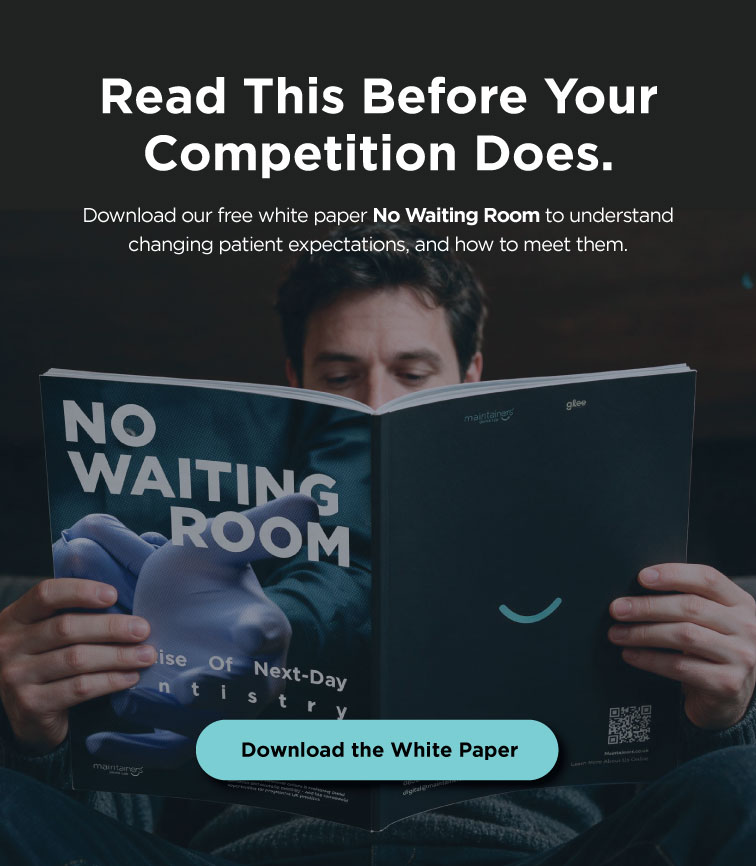
NO WAITING ROOM
The Future of UK Dentistry: Patient Expectations, Digital Dentistry and Practice Growth
Patient expectations are changing, and so is dentistry. Today's patients expect faster treatment, greater convenience and seamless digital experiences—and the practices that adapt will be best placed to grow.
No Waiting Room is an evidence-based white paper from Maintainers Dental Lab, developed in partnership with Working the Future. It explores the key trends shaping the future of UK dentistry, from changing consumer behaviour, digital dentistry and new opportunities for sustainable practice growth.
Download your free copy to discover:
- How patient expectations are reshaping dental practice.
- The latest trends in digital dentistry and technology.
- Opportunities to improve patient experience and operational efficiency.
- Practical strategies to drive practice growth and future-proof your business.
Complete the form to access your complimentary copy and gain the insights you need to build a more efficient, profitable and patient-focused dental practice.
The Same-Day Standard: What Changing Patient Behaviour Means for UK Dental Practices
Patients now expect speed, transparency and results that match what they've already decided they want. Here's what's driving that shift — and what to actually do about it.
A takeaway order gets tracked door-to-door in real time. A parcel ordered after midnight can be on the doorstep before lunch. Set against that, a three-week wait for a retainer or a whitening tray doesn't read as normal service anymore it reads as a reason to look elsewhere. Dentistry isn't a special case here. It's simply one of the last sectors to feel the full force of a consumer shift that's already reshaped retail, food and most of healthcare's private-pay corners.
What follows maps five separate but connected forces behind that shift: how fast patients now expect treatment to move, how social media has changed what they think they're entitled to look like, why an ageing and increasingly wealthy population is a bigger opportunity than most practices treat it as, which technologies are genuinely compressing timelines rather than just adding cost, and where the new revenue actually sits once you look past the appointment book.
Each section closes with a short, practical takeaway rather than just a summary of the research, and each is written to work as a standalone topic in its own right, so if one of these is closer to a live decision for your practice than the others, treat this as the starting point for a deeper piece on that specific topic, not the last word on it.
1. Speed Has Become the Product
The UK cosmetic dentistry market is growing at a pace few corners of private healthcare can match: valued at around £214 million in 2024, one projection puts it at £284 million by 2029, and a separate long-range estimate has it climbing from £211 million to £332 million over the decade to 2033. Search behaviour tells the same story from a different angle — enquiries for clear aligner brands are up 89% year on year and implant searches have risen 67%, with composite bonding now the fastest-growing category, largely on the back of younger patients chasing an affordable, quick smile upgrade.
None of that growth is happening in isolation from how people shop for everything else. Fast delivery is now cited by 96% of shoppers as a factor in what they buy, and more than a third say they've actually switched brand to get something quicker. For under-35s the number climbs further still — over half treat same-day delivery as the default, not the exception. Retailers reset that bar first, and the effect has since spread well beyond retail into wellness and aesthetics, where today's patient researches on their phone, compares providers in real time, and expects to be told upfront what something will cost and how long it will take.
Aligners are only the headline act. Whitening may be moving even faster: the global market is on course to grow from roughly £6.1 billion to £9.4 billion, and 84% of 18–35-year-olds in the UK already buy whitening products, most having discovered them via social media rather than a dentist's recommendation. Night guards, retainers and sports guards are following a similar curve, helped along by rising bruxism diagnoses. What makes this group of products interesting commercially is that none of them are a one-off purchase — patients come back for replacements and upgrades, which is exactly the kind of demand a practice can build steady revenue around rather than treating as an occasional treatment.
Put those two things together and the commercial logic is fairly blunt. Patients aren't only asking for more cosmetic and orthodontic work, they're asking for it fast, and their spend follows whoever can deliver that. A practice that can turn around a retainer or whitening tray overnight rather than in two or three weeks isn't offering a nicer-to-have — it's simply meeting an expectation patients already carry about everything else they buy. That is Maintainers lab made this leap to meet that patient demand no only providing a next day service on its ortho appliances.
|
PRACTICE TAKEAWAY • Time your current turnaround on your three most-requested appliances, and check whether patients are ever told a timeframe before they have to ask. • If whitening or night guards aren't actively marketed, they probably should be — patients are already searching for them. • Ask your lab partner what genuinely fast (not "fast for a lab") looks like in writing, and price your offer around it, or just register with maintainers lab |
2. What Patients See In The Mirror Has Changed
A lot of what drives a cosmetic consultation now starts on a screen rather than in a mirror. In the UK, social media is estimated to shape 73% of cosmetic dental decisions among 25–45-year-olds, the age band that also does most of the paying for private treatment, and one widely cited study found 72% of patients choosing cosmetic dental work had been influenced directly by an influencer post. Orthodontists are seeing it from the clinical side too: over a third report adult patients openly referencing celebrities or influencers, and seven in ten patients now research treatment online before ever booking a consultation, a chunk of what they find, by practitioners' own estimate, is inaccurate.
Two identifiable behaviours sit behind a lot of this. Researchers now use the term 'Snapchat dysmorphia' for patients requesting procedures that would make them resemble their own filtered selfie rather than their actual face — a phenomenon strong enough that over a third of people say the act of taking selfies alone increases their appetite for cosmetic work. Video calling has had a comparable effect from a different angle: watching yourself talk in real time and unfiltered turns out to be a far less flattering experience than a still photo, and the majority of dermatologists treating cosmetic concerns report patients naming video calls specifically as what pushed them to book.
Psychologists had already flagged rising 'socially prescribed perfectionism', the sense of being judged against an impossible standard, before social media accelerated it further; the trait grew by a third among young people between 1989 and 2016, and nearly all of today's Gen Z and millennial social media users in the UK (98% and 97% respectively) now spend large parts of their day inside platforms built to surface only the most polished version of everyone else. The most visible recent expression of that pressure is 'looksmaxxing', a male-focused pursuit of facial 'optimisation' that jumped from fringe online forums to mainstream TikTok virality. Nearly half of self-identified looksmaxxers say they're considering an aesthetic procedure, and male face and neck procedure volumes are up 26% since 2024 — an extreme case, but a fast-moving signal of male demand most practices still aren't pricing into their marketing.
For a practice, the read-through isn't complicated: patients are arriving with a firm, pre-formed idea of what they want, built from content they saw before they ever picked up the phone. Practices that can meet that expectation with fast, high-quality aesthetic work, and that speak the same visual language patients already use to describe what they want, are best placed to convert a cohort that is motivated, self-directed, and willing to pay for a result they've effectively already chosen.
|
PRACTICE TAKEAWAY • Treat your before/after content and social presence as a genuine acquisition channel, not an afterthought — patients are deciding what they want before they call. • Build extra time (or a script) into consultations where the patient's reference point is a filtered photo rather than their actual smile. • Don't assume aesthetic demand is female-skewed by default — male enquiry volumes are moving fast and most marketing hasn't caught up. |
3. The Growth Segment Hiding In Plain Sight
Here's a statistic that surprises most people outside the profession: in 1978, over three-quarters of over-65s in England had lost every natural tooth. By 2023 that figure had collapsed to 4% among 65–74-year-olds and 11% among the over-75s — nine in ten people over 75 now keep their own teeth. That single shift changes what an older patient actually needs from a dentist: not dentures, but maintenance, restoration and, increasingly, the same aesthetic work a 30-year-old might ask for.
That matters because of the sheer scale of who's ageing. Roughly one in five people in England, around 11 million, is already 65 or older, and the ONS expects the over-75 population to roughly double by 2039. Project further out and, by 2065, close to half the UK population will be over 50. Whatever a practice's patient mix looks like today, this is the direction it's moving in — and it's moving faster than most five-year plans account for.
It's also a demographic with the money to act on it. Over-50s hold more than three-quarters of the UK's household wealth and around £320 billion in annual spending, growing faster than any other age group over the past decade; by 2030 they're projected to account for roughly 60% of all UK consumer spend. That's already showing up in aesthetic treatment volumes: cosmetic procedures across the UK rose 12% in 2025 alone, and the single biggest jump in demand came from the 45–64 bracket, not from younger patients. Delve deeper into this patient group in our article: The missing middle >
Layer the collapse in NHS dental access on top and the opportunity sharpens further. Only two in five adults in England managed to see an NHS dentist in the two years to March 2024, and there are 483 fewer NHS dentists than before the pandemic. An older patient base with intact teeth, real disposable income, rising aesthetic expectations and shrinking NHS access is about as clear a commercial signal as a practice is likely to get, and it applies just as much to mixed and NHS-facing practices as to fully private ones.
|
PRACTICE TAKEAWAY • Look at your last 12 months of new patients aged 40+: is your marketing, and your treatment coordinator's script, actually built for this cohort, or still pitched at a younger buyer? • Consider whether maintenance or retention appliances are positioned as an add-on for older patients or as a core offer in their own right. • If you're NHS-facing, a modest private or elective menu can capture this demand without disrupting your core model. |
4. The Lab And Chairside Technology Actually Moving The Needle
Of the technologies reshaping dentistry right now, artificial intelligence is doing the most, the fastest. Diagnostic tools are already spotting caries and periodontal disease from radiographs at better than 90% accuracy, and some models predict treatment outcomes with up to 73% accuracy — a genuine gain in clinical precision, not a marginal one. Away from the chair, AI is arguably doing something even more disruptive to how a practice runs day to day: automating as much as 90% of patient care admin, from scheduling to follow-up to case-acceptance prompts, freeing up time clinicians can put back into actual treatment.
3D printing has made a similarly decisive jump from interesting to essential. The UK market for it in dentistry was worth around £102 million in 2024 and is forecast to reach £420 million by 2035, with one estimate going as high as £697 million by 2032, and it's now the default way aligners, retainers, surgical guides and brackets get made, to a precision hand-finishing struggles to match. The practical effect is that a process which used to take a lab two or three weeks can now, in the right setup, take a day or less.
Considering setting up you own in practice lab? get an in-depth look it to the pros and cons in our article - Is Running an In-House Dental Lab Really Worth It?
Robotics sits further behind in everyday adoption, but the direction of travel is unmistakable. The first FDA-cleared robotic dental surgery system, Yomi, in the US, is already placing implants with a precision manual technique struggles to match, and in July 2024 an autonomous, AI-guided robot completed a full dental procedure on a patient roughly eight times faster than a human dentist working manually. Nobody is suggesting fully autonomous chairside robotics is imminent in a typical UK practice, but assisted and augmented applications are closer than most owners assume.
Underneath all three of those sits a far less glamorous but genuinely foundational shift: the move to digital scanning. Intraoral scanners have got both more accurate and more affordable, replacing physical impressions with a same-visit 3D capture a lab can start working from immediately, cutting remakes and shaving real time off a patient's treatment journey. It's the unglamorous layer that makes everything above it possible, and practices that haven't made that switch yet are, in effect, capping how fast anything downstream of it can move.
|
PRACTICE TAKEAWAY • If your practice still relies on physical impressions as standard, that's the highest-leverage single upgrade available — everything else here depends on it. • Ask your current lab partner what their actual turnaround is on digital cases versus analogue ones; the gap is often bigger than owners assume. • You don't need to adopt AI or robotics wholesale — even automating booking confirmations and follow-up is a real, low-effort win. |
5. Where The Money Actually Moves From Here
Private care already does the heavy lifting in UK dentistry, 69% of the market by value and roughly £8.4 billion in 2023–24, and orthodontics is the fastest-growing slice of it. The European clear aligner market alone is expected to grow from £1.5 billion in 2023 to over £15 billion by 2033. What makes aligner patients particularly valuable isn't just the treatment fee: a typical case runs 6-18 months and naturally opens the door to retainers, whitening and maintenance products afterwards, a far longer commercial relationship than a single appointment.
There's a cautionary case study worth knowing here. The best-known direct-to-consumer aligner brand, once valued at £7 billion, collapsed into bankruptcy in September 2023, mid-treatment, for a large number of UK customers. The clinical bodies had flagged the risk well before that: skipping proper in-person assessment means conditions like gum disease or decay can go undiagnosed while treatment actively continues, which is precisely why the General Dental Council's 2021 guidance treats orthodontic treatment as something that requires direct clinician oversight, not an app. The real lesson isn't that patients were wrong to want speed and lower cost — they weren't — it's that the version of speed and cost worth having still needs a dentist attached to it.
Even within a properly supervised model, plenty of practices leak demand simply by responding too slowly. Contact a lead within five minutes and they're roughly ten times more likely to convert; the average UK practice takes 47 hours to respond. Practices that put a structured, automated follow-up process in place see conversion rates rise by close to half. A short digital pre-assessment on a website, a few questions on goals, photos, contact details, does a lot of that work automatically, turning the website itself into something closer to a round-the-clock enquiry desk than a static brochure.
A separate decision worth flagging: a number of practices, chasing tighter margins, have tried building an in-house lab rather than working with an external one. In practice this usually means absorbing significant equipment cost, hiring CAD-trained staff, and carrying the risk of backlogs whenever volume spikes, overheads that are easy to underestimate at the planning stage. For most practices, outsourcing to a specialist lab gets the speed and appliance quality without carrying that fixed cost and technical risk directly.
The longer-term shift worth watching is away from one-off treatment fees and toward membership-style models. Practices running structured plans report a first-year revenue increase in 82% of cases, and enrolled patients typically accept 50–75% more treatment than patients without one. Repeatable products, retainers, night guards, whitening trays, are the natural backbone of this: patients need replacements and upgrades on a predictable cycle, which turns what would otherwise be occasional, appointment-led income into something closer to a subscription.
|
PRACTICE TAKEAWAY • If you don't currently track lead response time, start — five minutes versus 47 hours is the single biggest lever most practices aren't pulling. • A simple online pre-assessment form is a low-cost build with an outsized effect on conversion. • Model what a basic membership plan (retainers, whitening, check-ups) would do to your recurring revenue before ruling it out as "not for us." |
The Thread Running Through All Five
Pull these five shifts apart and they look unrelated: a demographic trend, a psychological one, a couple of supply chains, a market correction. Put them back together and they point at the same thing from different directions. The patient in the chair has more information, more comparison points and less patience than the patient your business model was probably built around, whether they're 22 and influenced by a TikTok transformation video, or 55 and sitting on more disposable income than any previous generation of retirees.
None of this requires a practice to reinvent itself overnight. Most of what's above breaks down into specific, ownable decisions: how fast an appliance actually reaches a patient, how quickly a lead gets a reply, whether a maintenance plan exists at all. Each of the five sections above is deliberately written to expand into its own piece, because each one is really a separate decision a practice can make on its own timeline, not a single package that has to be adopted all at once.
If any one of these five areas is closer to a live decision for your practice than the others, that's usually the sensible place to start.